


説明
Temperature is not a setting — it is a material property. Vinyl wrap softens at 180°C. Powder coating flows at 200°C. Lead-free solder melts at 217°C. Epoxy releases at 300°C. A heat gun with two temperature presets forces you to choose between 'too cold to work' and 'hot enough to damage.' The Heatweaver eliminates this compromise with a continuously variable temperature dial calibrated from ambient to 600°C — every material has its thermal window, and now your heat gun can meet it exactly.
The 2000-watt element is the same class as fixed-temperature industrial guns, but the addition of a variable thermostat and a 300-500 L/min airflow control transforms the tool from a blunt instrument into a precision thermal device. At 200°C with the concentrator nozzle, the Heatweaver activates heat-shrink tubing evenly without scorching the wire insulation beneath it. At 400°C with the spreader nozzle, it softens automotive-grade vinyl wrap for compound-curve installation on a door panel. At 600°C with full airflow, it strips a decade of paint from a window frame in less time than it takes to set up a chemical stripping station. The variable dial is not a convenience feature. It is the architecture that makes a single tool competent across six different material workflows.
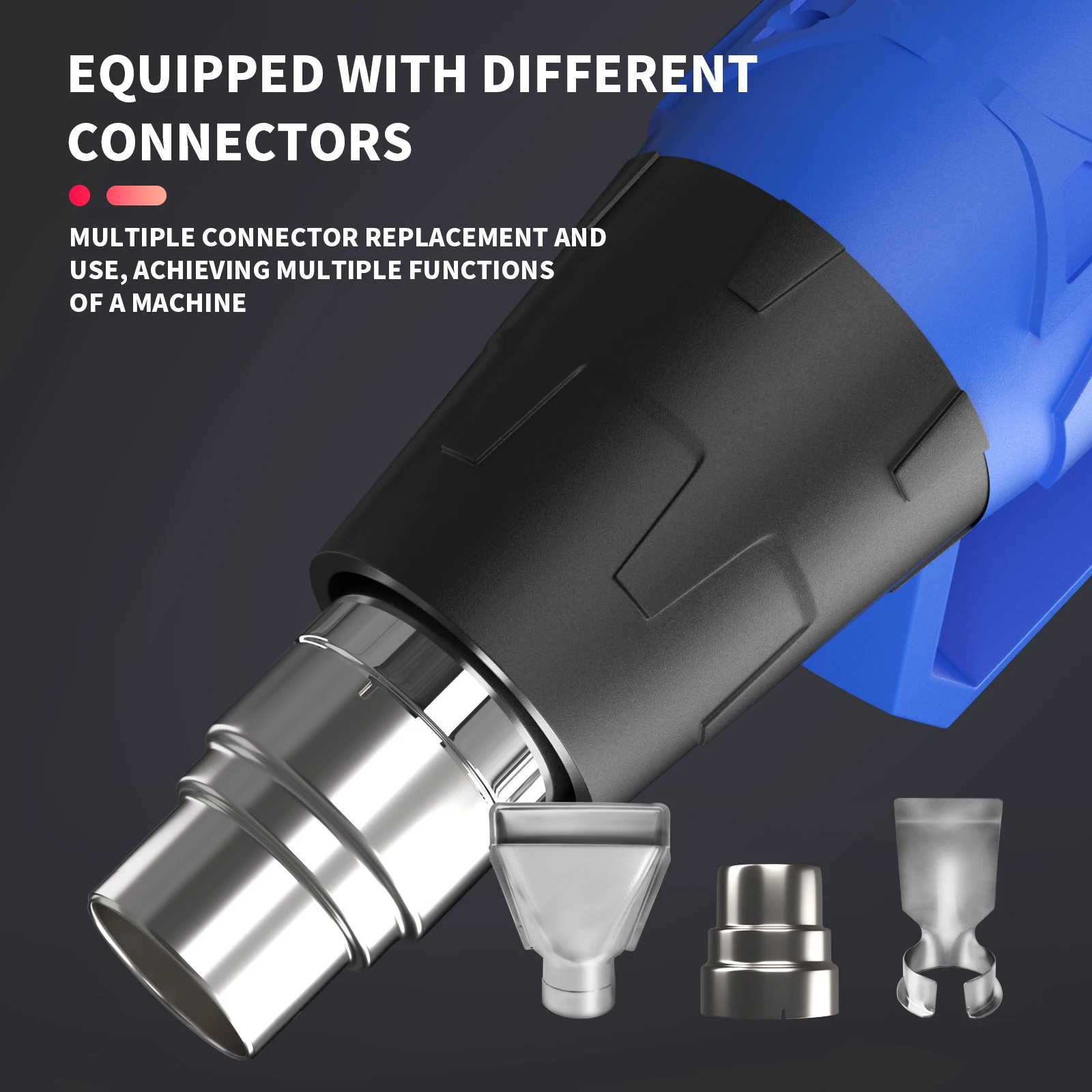
The three included nozzles — concentrator, spreader, and reflector — cover the full application spectrum. The integrated bench stand deploys in one motion and keeps the 600°C nozzle safely elevated when you need both hands for material manipulation. A 2-meter power cord provides workshop reach without an extension lead, and the contoured grip with rubberized overmold reduces hand fatigue during extended stripping sessions. Overload protection cycles the element off before thermal damage occurs, resetting automatically after cooling — the kind of safety feature you never notice until the tool that lacked it dies on the third panel of a six-panel stripping job.
This is not a binary on/off heating tool. It is an analog thermal instrument for people who work with materials that have opinions about temperature.
Key Features
- ✦Continuously Variable Temperature: Analog dial from 50°C to 600°C — not stepped presets. Every material from heat-shrink tubing (200°C) to automotive paint stripping (600°C) has a thermal window, and the dial finds it exactly.
- ✦2000W Industrial Element: Sustained high output without the thermal cycling sag that makes budget heat guns struggle on continuous stripping jobs.
- ✦Variable Airflow 300-500 L/min: High volume for broad-area coverage, low volume for precision electronics and heat-shrink work where excessive airflow disrupts the target.
- ✦3 Interchangeable Nozzles: Concentrator nozzle (precision stripping, SMD reflow), spreader nozzle (broad coverage, vinyl wrap), reflector nozzle (360° heat-shrink tubing). Tool-free press-fit changes.
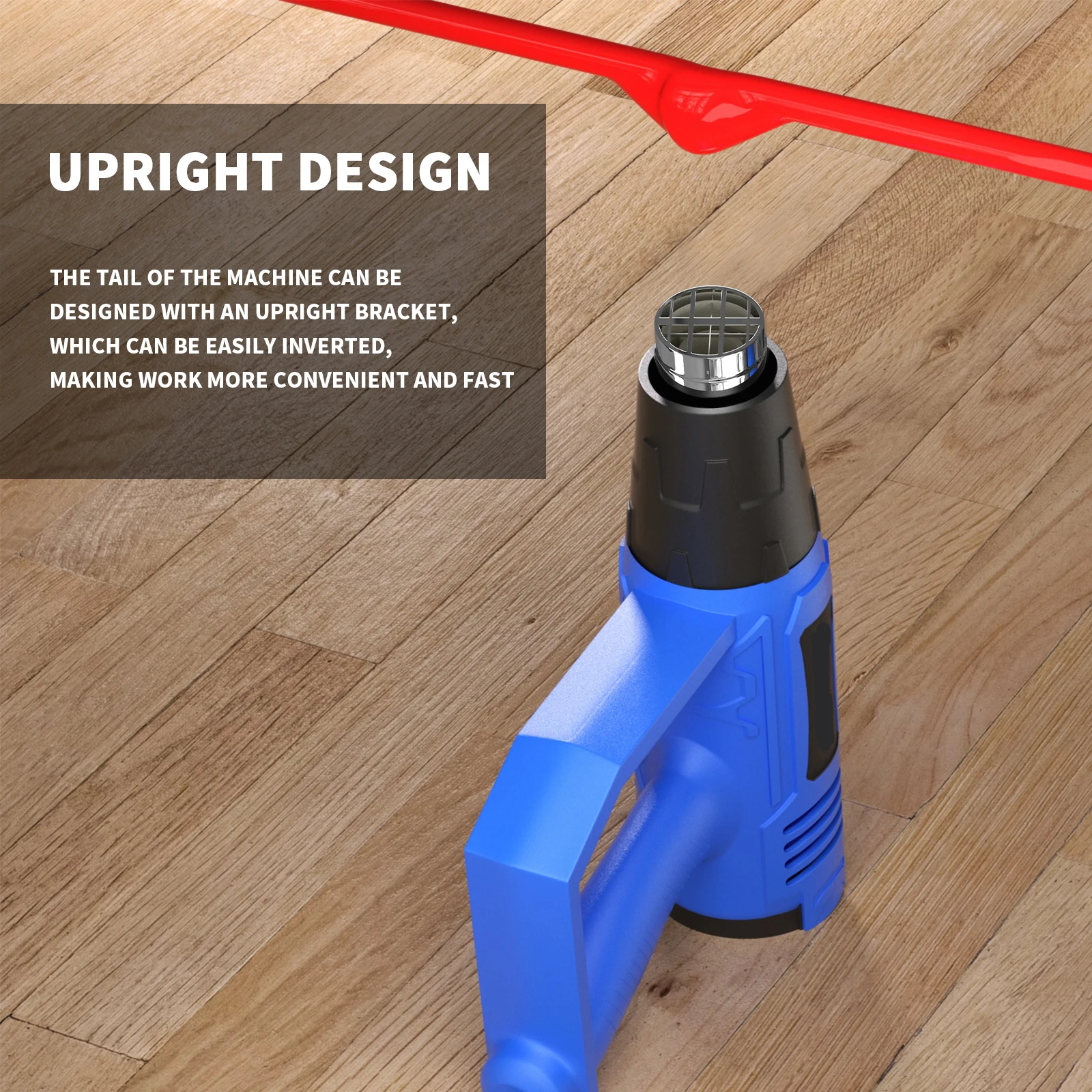
- ✦Integrated Bench Stand: One-motion deployment keeps the hot nozzle elevated and directed safely away from the work surface during hands-free operation.
- ✦Thermal Overload Protection: Automatic element cycling prevents burnout from continuous maximum-temperature operation. Resets after cooling — protects both tool and workpiece.
- ✦Ergonomic Rubberized Grip: Contoured handle with rubber overmold for extended-use comfort. 2-meter power cord for workshop reach without extension leads.
Technical Specifications
- Power Rating: 2000W
- Temperature Range: 50°C - 600°C (continuously variable dial)
- Airflow Range: 300-500 L/min (variable)
- Heat-Up Time: ~90 seconds to operating temperature
- Nozzles Included: 3 (concentrator, spreader, reflector)
- Nozzle Mount: Industry-standard 32mm press-fit
- Voltage: 220V AC, grounded 3-prong plug
- Power Cord: 2 meters
- Safety: Thermal overload protection, integrated stand
- Applications: Paint stripping, heat-shrink tubing, SMD reflow, vinyl wrap installation, adhesive removal, plastic welding, pipe thawing, seized bolt release
Application Scenarios
The Heatweaver's variable-temperature architecture makes it the default tool for multi-material workshops where no two jobs require the same thermal profile. Automotive vinyl wrap installers set the dial to 180-220°C — the sweet spot where cast vinyl becomes pliable for compound-curve application without exceeding the polymer''s deformation threshold. Electronics repair technicians work at 200-300°C with the concentrator nozzle for SMD component reflow, heat-shrink tubing activation, and smartphone screen adhesive release — all tasks where a fixed 600°C gun would destroy the target in seconds. Woodworking shops use the 300-400°C range for paint softening prior to scraping, veneer release on restoration projects, and hide-glue reactivation on antique furniture. Plumbers apply 400-500°C for frozen pipe thawing and seized compression fitting release — hot enough to work, controlled enough not to scorch surrounding materials. The variable dial means the Heatweaver replaces not one tool but a hierarchy of single-temperature guns that accumulate in workshop drawers because "this one's for electronics" and "that one's for stripping." One tool, one dial, every thermal window covered.
Frequently Asked Questions
Q: How do I know what temperature to set for my material?
A: The variable dial is unmarked — this is intentional. Material temperature requirements vary by thickness, ambient conditions, and application technique. Start at a low setting and increase gradually while testing on a scrap piece or inconspicuous area. The thermal window for most materials is well-documented: heat-shrink tubing ~200°C, vinyl wrap 180-220°C, paint softening 300-400°C, solder reflow 217°C (lead-free).
Q: Can the variable dial be accidentally bumped during use?
A: The dial has sufficient resistance to maintain its setting during normal operation. It is positioned on the rear of the housing, away from the grip area — not in a position that your hand contacts during use.
Q: Is there an advantage over the dual-temperature model?
A: For users who work with a wide range of materials, the variable dial eliminates the compromise of choosing between "too cold" and "too hot." If your heat-gun work is exclusively high-temperature stripping, the dual-temperature model at a lower price point may be sufficient.
Q: How long does it take to cool down after use?
A: The nozzle remains hot for 15-20 minutes after shutdown. Always place the tool on its integrated stand with the nozzle directed upward and away from surfaces. Do not store until the nozzle is cool to the touch.
Q: Can I use it for crafting and art projects?
A: Yes. The low-temperature range (50-150°C) is suitable for embossing powder activation, wax manipulation, and thermochromic material work — crafting applications that fixed-temperature guns cook rather than activate.
Q: What voltage does it require?
A: 220V AC with grounded 3-prong plug. Standard for Europe, Asia, Australia, and most regions outside North America.
Q: Are replacement nozzles available?
A: The three included nozzles cover the primary workflows. The 32mm press-fit mount is the industry standard — nozzles from most manufacturers are compatible.


Customer Reviews
Payment and Security
お支払い情報は安全に処理されます。 クレジットカードの詳細を保存したり、クレジットカード情報にアクセスすることはありません